On December 7, 1949, the Republic of China retreated from mainland China to the island of Formosa (later renamed Taiwan), a serious loss to the communist People’s Republic of China. Since then, the Republic of China has maintained control over the island of Taiwan while its communist counterpart watched from the mainland. Taiwan still identifies itself as a sovereign nation, while China views it as a separatist territory in need of reunification.
In 1986, the Democratic Progressive Party (DPP), Taiwan’s first opposition party, formed and demanded a shift toward democratic tendencies. By 1996, Taiwan had held its first democratic election and has since become one of Asia’s most progressive countries, upholding a strong democratic tradition, protecting LGBTQ+ rights to a degree unheard of in Asia, and even electing a woman president, Tsai Ing-wen, in 2016. China, on the other hand, has not only remained fiercely authoritarian but also pushed for Taiwan to be placed back under its control. As of November 2021, the diplomatic dispute continues.
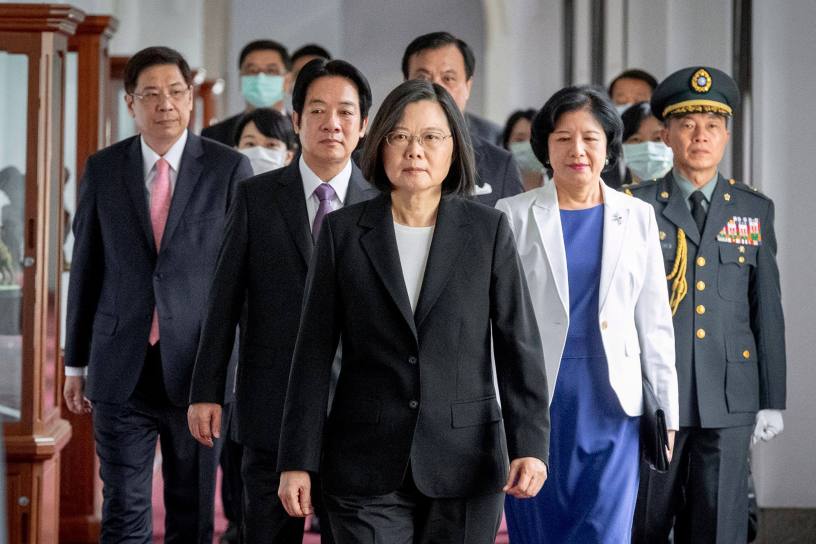
Currently, a buildup of diplomatic tension over the past five years seems to be crescendoing. The shift started on May 20, 2016, when Tsai Ing-wen was inaugurated as president of the Republic of China. In contrast to the cordial diplomacy of her predecessor, Ma Ying-jeou, Tsing was unyielding when conducting foreign policy with the mainland. She further shook up China-Taiwan relations when she called then-U.S. president-elect Donald Trump in December 2016, the first time such a call had taken place since the United States cut diplomatic ties with the island in 1979. The renewed diplomacy with the U.S. had the potential to assist Taiwan in its dealings with China.
Tsai was correct, and on July 9, 2019, to Beijing’s dismay, the U.S. sold $2 billion worth of military equipment to Taiwan, demonstrating the country’s support for the island democracy. This was followed on October 22, 2020, by a second arms sale of $1.8 billion that included sensors, artillery, and rocket launchers. The U.S. further increased their foreign relations with Taiwan in April 2021, when the U.S. State Department’s new guidelines promoted diplomacy with Taiwan and the island nation was later invited to a meeting at a U.S. embassy in France. On June 6, 2021, the U.S. even delivered 750,000 COVID-19 vaccines to Taiwan, which arrived in a U.S. military plane along with a delegation of three senators. While President Tsai welcomed the “timely rain,” Beijing viewed the donation and military demonstration as a threat from Taiwan’s newly-reacquired democratic ally.
Over the past month, diplomacy between the two Republics of China has worsened further. In October 2021, China flew a record number of fighter jets into Taiwan’s protected air space just days ahead of the democratic island’s national day. Soon after on October 9, the demonstration was followed by a speech from Chinese President Xi Jingping, in which he declared that “reunification” with Taiwan “must be fulfilled.” According to him, this would best be achieved peacefully, but the people of China have a “glorious tradition” of combating separatism. Taiwan, under the leadership of President Tsai, claimed its future lies in the hands of its people.
On November 10, 2021, China executed a fighter jet military drill in the Strait of Taiwan in response to a U.S. diplomatic delegation to the island. China’s Defense Ministry claimed that the “joint war preparedness patrol” was due to the “seriously incorrect words and actions of relevant countries over the issue of Taiwan.” According to the ministry, the exercise was a “necessary measure to safeguard national sovereignty.” Others argue these demonstrations, along with President Xi’s threats, are signs that an invasion is imminent.
Neither side shows any signs of backing down. While China doubles down on military demonstrations in the island’s airspace, Taiwan’s people provide the fiercely-anti-China Tsai administration with bold electoral mandates and Taipei-Washington diplomacy grows stronger. On October 21, American President Joe Biden announced in a town hall that the U.S. has a “commitment” to come to Taiwan’s defense if China invaded. Only time will tell if the United States will have to fulfill that promise.
 The Global Monitor