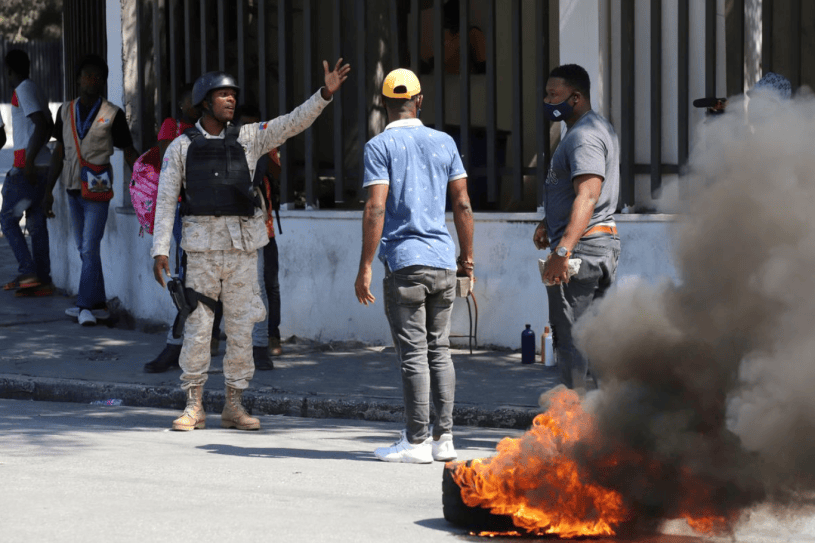
The streets of Haiti are silent and its hospitals near-empty as the days-long national fuel shortage continues throughout the country. Emerging from a global pandemic as well as recovering from the major earthquake in August, this fuel shortage spells the latest in a series of disasters in the country.
G9, a coalition of Haiti’s nine strongest gangs based in Port-au-Prince, has blocked access to the country’s fuel stores as they demand the resignation of Prime Minister Ariel Henry. This attack reflects the escalating and increasingly political role of gang violence in Haiti following the assassination of former President Jovenel Moise in July of this year. Led by Jimmy “Barbecue” Cherizier, a former policeman who created G9 in 2020 for what he calls a “revolution” against Haiti’s rule of law, has been accused of orchestrating several massacres and is now responsible for leading the ongoing disaster afflicting Haiti.
While longstanding structural and economic issues have also contributed to the ongoing national fuel shortage, this crisis was primarily instigated by G9’s actions. Fuel is imported to Haiti at Carrefour and Varreux ports, both located in Port-au-Prince. Access to these ports is restricted to two highways, both of which are now barricaded by roadblocks as part of G9’s latest attack on the nation. Attempts to pass these roadblocks and bring fuel to the rest of Haiti have been deterred with violence and risk of kidnapping, and the fuel that is allowed to pass through comes at highly inflated prices of up to $20,000 per tanker. However, the gang’s primary motive in blockading Haiti’s access to fuel is not purely monetary. In an October 25th interview, Jimmy Cherizier stated on Haiti’s Radio Mega that, “The areas under the control of the G9 are blocked for one reason only – we demand the resignation of Ariel Henry,” and that “If Ariel Henry resigns at 8:00 am, at 8:05 am we will unblock the road and all the trucks will be able to go through to get fuel.” Henry has yet to make an official statement in response to these demands.
This shortage greatly affects the country as a whole. The little gas that does make it through the blockade is sold at prices far too high for what the average family can afford, and many businesses have been forced to close due to the inability to function without the necessary fuel. Even Haiti’s largest industries are experiencing a sharp decline in production. Some worry that this will have great economic ramifications, and worsen inflation within Haiti. Protests and strikes have happened across the country to implore the government to take action at the crisis.
Hospitals, the majority of which rely on gasoline-run generators, have also been severely impacted by the crisis. As a result, many hospitals have been forced to minimize capacity, turning away a large majority of would-be patients as they do not have the ability to provide them with care. Haitian medical centers such as Innovating Health International (IHI) are fighting to continue providing crucial services and care to their patients, but their fuel is being bought at too-high prices in too-little quantities. This critically endangers the health of the Haitian people, who are already steadily losing access to more and more resources the longer the crisis continues. In response, organizations such as UNICEF are trying to send fuel to Haiti in response to SOS messages to help alleviate the emergency. For example, the organization has created a contract with a local provider to provide 10,000 gallons of fuel to Haiti, with the primary purpose of aiding hospitals. UNICEF has also supported the Haitian Ministry of Health in building solar panels to provide power, though the energy gained from solar panels is insufficient for the hospitals’ needs. Unfortunately, this is only a short-term solution until the blockades at Haiti’s ports are lifted.

