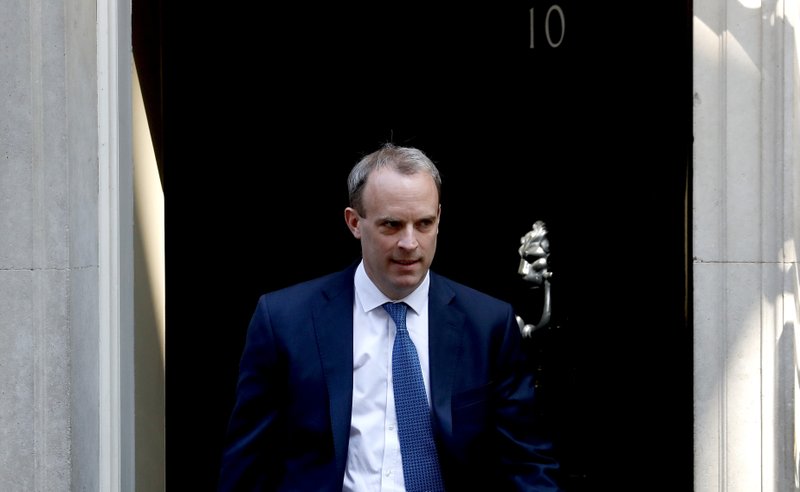
Dominic Raab, the British Foreign Secretary, officially announced in Parliament on July 21 that the United Kingdom would be suspending an extradition treaty and extending an arms embargo to Hong Kong. The decision was triggered by China’s passage of the controversial National Security Law, which grants China greater power in the semi-autonomous Hong Kong, including the criminalization of secessionist speech.
In Parliament, Raab remarked on China’s positive role in the world, through their investments in infrastructure and green energy, as a prologue to the British condemnation of the new legislation: “We have been clear regarding the new National Security Law, which China has imposed on the people of Hong Kong, a clear and serious violation of the UK-China joint declaration, and with it a violation of China’s freely assumed international obligations.”
Raab goes on to address two new changes to British relations with Hong Kong: the arms embargo and the extradition treaty. Regarding the former, Raab states: “First, given the role that China has assumed for the internal security of Hong Kong…the UK will extend to Hong Kong the arms embargo that we’ve applied to mainland China since 1989. To be clear, the extension of this embargo will mean that there will be no exports from the UK to Hong Kong of potentially lethal weapons, their components, or ammunition. And it will also mean a ban on the export on any equipment not already banned which might be used for internal repression…”
Regarding the suspension of the extradition treaty, Raab firmly expressed concern over the Chinese extending their jurisdiction over certain cases in Hong Kong, measures which Raab asserts, “significantly changed key assumptions underpinning our extradition arrangements with Hong Kong”. Raab, coming the conclusion that the new law “does not provide legal or judicial safeguards”, announced the suspension of the extradition treaty “immediately and indefinitely”.
The United Kingdom joins other countries that have condemned the new National Security Law. Australia, earlier this month, announced their suspension of their Hong Kong extradition treaty and extended Visas for students and workers. The Trump Administration also signed an executive action that will end a years-long preferential trade treatment for Hong Kong and a law passed by Congress that punishes banks that work with Chinese officials who helped pass the controversial law.
Tension Boil Over Between China and Hong Kong
The British government’s announcement comes at the heels of a proposed British plan to offer five year residency to the 350,000 British National (Overseas) passport holders in Hong Kong and provide a path to citizenship, a move that heightened tension between China and the UK. China responded to an original plan earlier this month, which would have extended the offer to all Hong Kong citizens, through their London embassy: “China urges the British side to view the national security issue in Hong Kong in an objective and fair manner, respect China’s stance and concerns, and not to interfere with Hong Kong affairs in any manner.”
Hong Kong’s history with China has been a long and controversial one. Conceded in 1842 to the United Kingdom after the First Opium War between China and the UK, both parties negotiated a ninety-nine year lease of the territory in 1898. With British control over the region, Hong Kong grew to become one of the “Asian Tigers” in the 1970’s, with a booming industrial and textile industry, in contrast to the struggling mainland China, which at the time was undergoing mass cultural and political changes after the implementation of a Maoist communist government post-Chinese Civil War. Leading up to the “hand off” of Hong Kong, set for 1997, in 1984 the British and Chinese governments sign a joint declaration, creating a “one country, two systems” model for the following fifty years after the “hand off”, allowing Hong Kong to retain a capitalist economy and partial democracy while becoming legally Chinese.
As Hong Kong creeps towards 2047, the year where China will assume full control over Hong Kong through the joint declaration, China has already begun to assert more dominance in the region, subverting Hong Kong’s democratic norms. Throughout the 21st century, Hong Kong has been divided between a pro-democracy camp, urging for greater political autonomy from Beijing, and a pro-Beijing camp. In 2014, with the Chinese firmly opposing full democratic elections for Hong Kong’s Chief Executive and asserting that only candidates approved by Beijing will appear on the ballot in 2017, protests began to riddle the streets of Hong Kong, amplifying a precedent of demonstrations against Beijing’s influence in Hong Kong.
In 2019, mass protests broke out after a bill was proposed in the Hong Kong legislature that would have allowed criminal suspects to be extradited to mainland China, a move that worried many in Hong Kong would subvert Hong Kong’s democratic judicial process, one that the mainland Chinese aren’t privy to. Though the bill was withdrawn in September 2019, the protests continued as the exposed wound of frustration in Hong Kong continued bleeding. To add to the fire, Beijing earlier this month passed a new security law that could possibly lead to the extradition of Hong Kong citizens to the mainland and will crush secessionist speech in the region.
 The Global Monitor