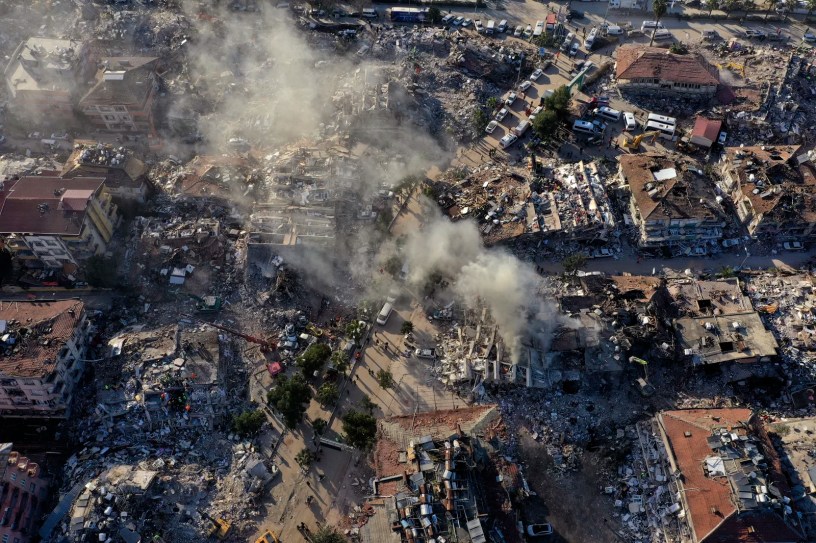
On February 6, 2023, a 7.8 magnitude earthquake struck the province of Kahramanmaraş near the Syrian border in southeastern Türkiye. A magnitude 7.5 tremor, triggered by the initial quake, struck nine hours later slightly to the north. Over 120 aftershocks have disrupted the region in the following days. The shaking was felt throughout parts of the Middle East, though the extent of the damage remains in Türkiye and Syria.
Turkish President Recep Tayyip Erdogan declared a three-month state of emergency, citing that the disaster affected 13 million of the nation’s 85 million citizens. The initial quake alone destroyed over 5,600 buildings in Türkiye. The World Health Organization estimates that roughly 23 million people, including 1.4 million children, will ultimately be impacted. Even before the earthquake, Syria has been suffering a humanitarian crisis–with 6.5 million children needing aid–due to the ongoing civil war. As of February 12, 2023, the death toll in both countries stands at 33,000 and counting.
The Kahramanmaraş earthquake has prompted international aid–in the forms of money, search and rescue teams, and humanitarian supplies–from countries including the United States, the United Kingdom, Italy, France, Spain, Russia, and Germany. As a whole, the European Union has pledged aid. Additionally, Israel sent a 150-member search and rescue team to Türkiye. Israeli Prime Minister Benjamin Netanyahu even approved a humanitarian aid request from Syria despite a lack of diplomatic relations with the country due to military conflict. On February 9, a relief convoy from the United Nations arrived in Syria, bringing food, water, cleaning supplies, and shelter. Experts and diplomats alike have discussed how Syria’s civil war makes humanitarian aid shipments particularly challenging. War-torn roads and infrastructure hamper transport of supplies. Meanwhile, U.S. and European sanctions on Bashar al-Assad’s government in Damascus mean several nations are reluctant to coordinate humanitarian response directly with the Syrian government. Some experts see the potential for the earthquake to open up the country to increased foreign aid in the future as Syrian refugees continue to suffer from the ongoing conflict.
Several factors have combined to make the Kahramanmaraş earthquake particularly deadly. The quake struck at 4:17 a.m. local time, meaning many people were in bed and subsequently crushed by the rubble of their own homes or apartment buildings. Meanwhile, the weather in the region has been wet and cold, and snowy conditions have made aid transport and rescue operations more challenging. Temperatures well below freezing have put trapped victims at risk of hypothermia. Additionally, many buildings have suffered “pancake” collapses, meaning a building’s entire structure completely collapses rather than just a portion of it. These types of collapses make rescue operations significantly more difficult. United States Geological Survey structural engineer Kishor Jaiswal explained that Türkiye has experienced severe earthquakes in the past, including a 1999 southwest Türkiye quake that killed over 14,000 people and led to improved regional building regulations. It is believed that many of the buildings that recently suffered pancake collapses were not up to date with the post-1999 Turkish architectural standards.
Six days after the earthquake, the United Nations warned the death toll could rise to over 55,000 as more bodies are found amidst the rubble. As search and rescue teams–including local civilians, soldiers, dogs, and rescuers sent from across the world–work tirelessly to uncover those trapped beneath the rubble, experts warn that the rescue window is closing. “Time is always the enemy,” says Ilan Kelman, professor of disasters and health at University College London. “Typically, few survivors are pulled out after 72 hours – yet every life saved is essential and some people are extricated after many days.”
It’s a race against time–and a test of foreign nations’ humanitarian generosity–as the world reels from the Kahramanmaraş earthquake’s unprecedented lethality.
 The Global Monitor