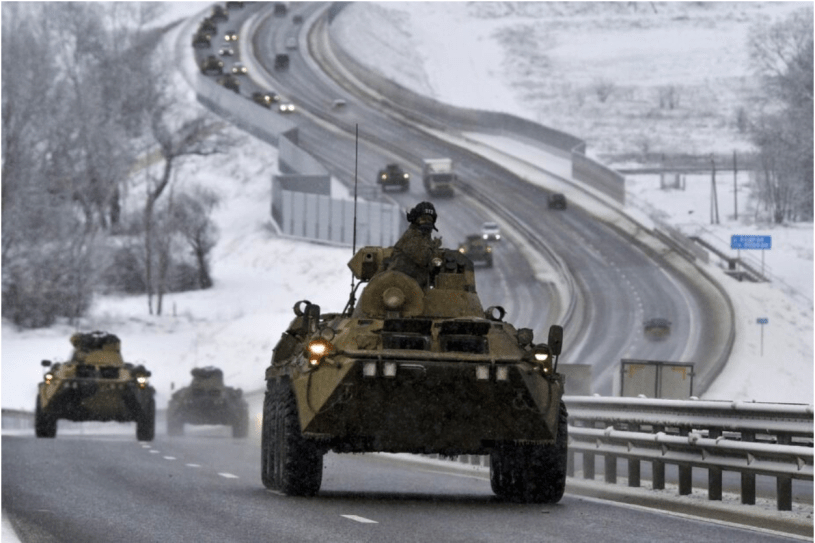
In December, Russia deployed about 100,000 troops and loads of heavy military equipment to its border with Ukraine. Russian President Vladimir Putin has claimed that the troop movement is due to a military exercise, yet Russia has recently given the North Atlantic Treaty Organization (NATO) a list of demands: a halt to all of NATO’s expansion into the east, Western military development in former Soviet territory, Western assistance to Ukraine, and intermediate-range missiles in Europe. However, NATO is unlikely to accept these aggressive demands. On January 19, American President Joe Biden said he believes that Russia is planning to move into Ukraine.
Russia’s drive to deploy troops is fueled by the fact that they do not want Ukraine to join NATO. If Ukraine were to join NATO, then they would be pushing up right against the Russian border, which would make them feel threatened by the Western alliance. Back in 2014, Ukraine overthrew pro-Russian president Viktor Yanukovych as it shifted towards more Western ideals, loosening Russia’s control. Feeling threatened by the growing Westernization of Ukraine, Russia responded by annexing the Crimean Peninsula to try to prevent Ukraine from joining NATO. As Ukraine has continued to become closer with the West, the idea of joining NATO has appealed to more Ukrainians. Russia’s main option seems to be taking decisive action to keep NATO at bay and send their message that unwillingness to obey could be met with a response similar to 2014, if not harsher. It is possible that Russia is hoping to overthrow the West-leaning Ukrainian government and establish their own government.
According to the British Foreign Office, there is “information that indicates the Russian government is looking to install a pro-Russian leader in Kyiv.” American and British forces are unsure of how Russia might execute this plan, saying that it could be done using many different methods, such as military invasion or running a campaign of disinformation against current Ukrainian president Volodymr Zelensky. British Intelligence did state that an ex-Russian lawmaker might be Russia’s candidate to lead Ukraine.
According to sources in Russian intelligence, some former officials from President Yanukovych’s staff have been preparing for a return to power in Ukraine. It is notable that the British intelligence has made these claims based on its assessment of the situation, and has kept any sources anonymous, which implies that the British might be making these claims to try to rattle Putin, or that the British actually do have sources within Russia that are giving this information. Reestablishing a pro-Russian government in Ukraine through military invasion would allow Russia to have a buffer zone protecting them from NATO and sets an example of what may happen in similar conflicts going forward.
Within NATO, there is division on how to respond to a possible Russian invasion. Some NATO nations, most notably the U.S., UK, and Canada, have already started to take action. First, the British have verbally shown their support for Ukraine, as they called for Russia to “de-escalate, end its campaigns of aggression and disinformation, and pursue a path of diplomacy.” The British also stated that “any Russian military incursion into Ukraine would be a massive strategic mistake with severe costs.” In terms of action, the British have been the most supportive to this point. They have sent 2,000 anti-tank weapons to Ukrainian troops this past week, and have been conducting regular surveillance operations with Royal Air Force C-17 aircrafts. Additionally, the British deployed 30 soldiers from the Ranger Regiment, their newly assembled special forces unit created in December. Similarly, Canadian special forces are reported to be deployed in Ukraine recently, although the Canadian government refused to officially comment on their presence. As for the USA, its $200 million in military aid was delivered to Ukraine on Saturday. It is also very likely that there are American special forces operators working in Ukraine, although their presence has not been confirmed by any officials. President Joe Biden stated that “I think he [Putin] will pay a serious and dear price for it [invading Ukraine] that he doesn’t think now will cost him what it’s going to cost him. And I think he will regret having done it,” signaling that the U.S. would respond with intense force if Russia attempts to invade.
While these three countries, along with some others, have made it clear that they will meet Russia head-on, some NATO nations are unsure about getting involved. President Biden also expressed that “there are differences in NATO as to what countries are willing to do, depending on what happened, the degree to which they’re able to go.” The level of unity in NATO will be crucial over the coming months, as the alliance attempts to stand its ground against growing Russian aggression. If Russia continues to harass smaller nations and attempts to gather Eastern allies, this conflict could very easily escalate into full-blown global clash, possibly creating World War III.
 The Global Monitor