The Suez Canal is a 120 mile-long man-made sea-level waterway in Egypt. It connects the Mediterranean Sea to the Red Sea, allowing ships on their way to Asia from Europe to significantly shorten their travel time. Typically, ships would have to sail around the entire coast of Africa to reach the Indian Ocean, leading to longer travel lengths and therefore more opportunities for sea and weather-based problems to arise. Today, the Suez Canal is one of the most used shipping lanes in the world. For example, in 2018, there were 18,174 transits with about 1,121,163,000 net annual tons.
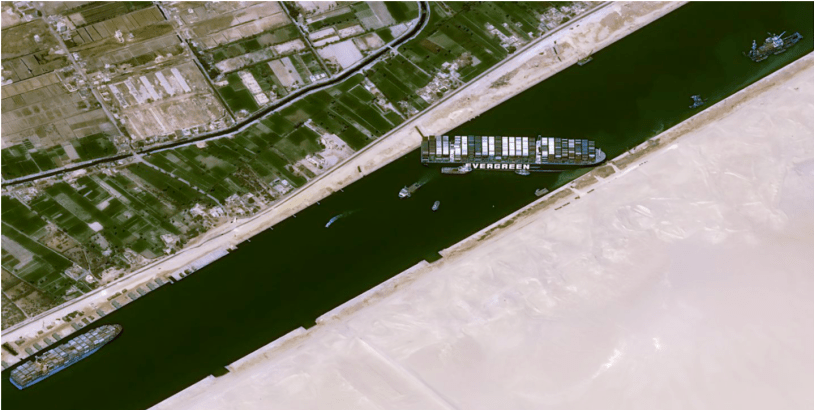
On March 23rd, the Ever Given, a ship heading to the Netherlands from China, ran aground in the canal and twisted diagonally so that no other ships could pass by. While the reasons for this accident are still being investigated, officials report that sandstorms coupled with high winds and other poor weather conditions were at least partially at fault for the ship losing its straight path. There is also an ongoing inquiry into the possibility of technical and/or human errors causing this event. Fourteen tug boats and large dredgers, which removed hundreds of thousands of cubic feet of sand from the canal’s bank, were the main machines used to free the ship.
Because 12% of international trade goes through the Suez Canal, each day trade was halted could cost up to $9.6 billion, making the worst case scenario up to $100 billion in economic losses. Additionally, nearly 1 million barrels of oil were blocked each day, thus affecting global oil accessibility and prices. The overall backlog has delayed shipments worth $12 billion, consisting of oil, furniture, coffee, and even live animals, from reaching their final destinations in Europe and Asia. Lars Jensen, CEO of SeaIntelligence said: “The dominoes have been toppled. The delays and re-routing which have already happened will cause ripple effects that will be felt for several months.” While American consumers will not feel as much of an effect because most shipments from Asia are carried out via the Pacific Ocean, there could still be some inflationary effects in the U.S.
Thankfully, the Ever Given was dislodged on March 29th and global trade is returning to normal. As of April 3rd, the backup caused by the ship was mostly taken care of. Looking forward, there may be new regulations that attempt to ensure that a scenario like this one does not reoccur.
 The Global Monitor