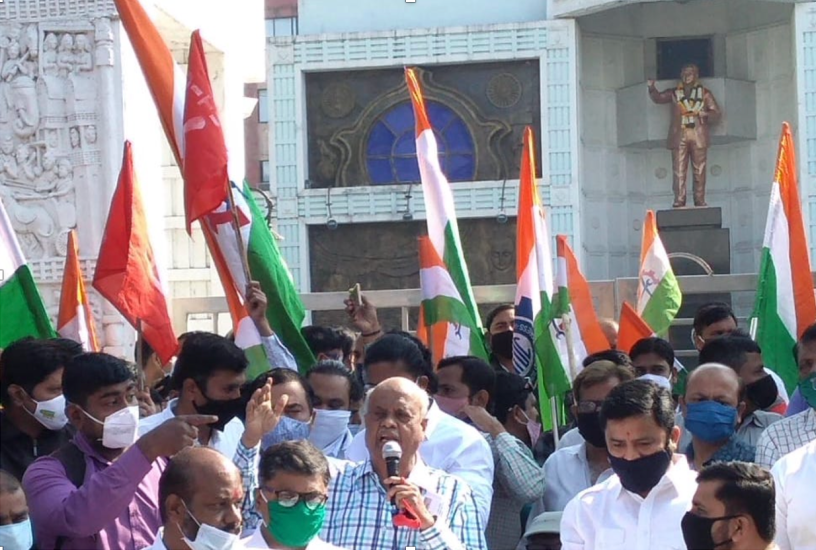
November 26th, 2020
“This is a revolution, sir.” – an Indian man protesting in the 2020 General Strike
On November 26th, 2020, an estimated 250 million Indian workers went on a general strike all across India, making it one of the largest, if not largest worker strike in history. The protest was organized by 10 Indian trade unions and was supported by many left-wing Indian parties, including the Indian National Congress and the Communist Party of India. Their main goal was to address recently passed laws that were deemed “anti-farmer” which the farmers claim would give much more power to large corporations.
The unions had 7 demands, including more monetary benefits, like remittances to those who earn less than the income tax threshold, as well as a universal pension. They also demanded a free grain ration to those who need it, as well as the expansion of job opportunities for workers. The Indian government, however, believes that these recently-passed laws help workers and promote technological advancement in farming.
In recent years, especially in response to the Bharatiya Janata Party (BJP)’s actions that are largely viewed as anti-worker, there have been protests by many Indians which are lauded by Western media yet relatively ignored by Indian media. As a result, life returns to normal, with little change occurring. The Indian
The American Response
The American response to the Indian General Strike has largely been various American-based South Asian groups, congresspeople, and ethnic leaders urging the Indian government to focus on addressing the issues the Indian workers are raising.
Because many of the protestors are from India’s northern states of Punjab and Haryana, their relatives and descendants living in the United States have used their cultural organizations to send messages to Prime Minister Modi. For example, the leaders of the Sikhs of America (representing a religious group which largely inhabits India’s northern states) wrote a letter to Modi asking him to officially recognize a protest from the North, which was part of the General Strike, as a national protest instead of a regional one.
Various U.S. lawmakers have also spoken out about the Indian protests. Both Democratic and Republican congresspeople, including Congressman Doug LaMalfa (R-CA) and Congressman Josh Harder (D-CA) have made similar remarks about how India is the world’s largest democracy and should allow their workers to protest freely in order to uphold such democratic principles.
India’s response to international comments like these has been to call them “ill-informed” and “unwarranted,” arguing that the protests were a matter of domestic affairs with no need for outside commentary.
There has not been much tangible or visible evidence of change for the Indian workers, but only time will tell the amount of progress that happens.
 The Global Monitor