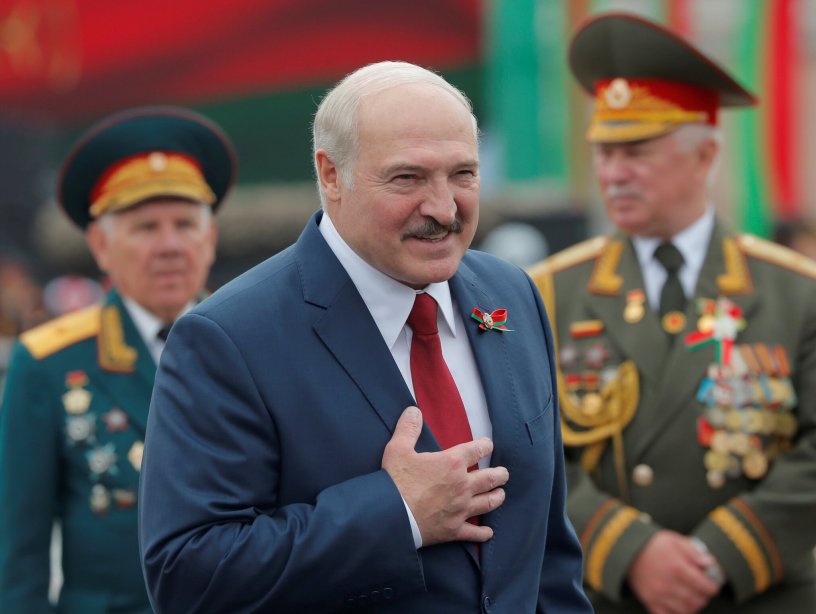
MINSK – Following the contested reelection of “Europe’s Last Dictator” in which Aleksander G. Lukanhesko claimed to have won over 80% of the vote, Minsk was rocked with thousands of protesters gathered in a rare demonstration against the now 26-year ruling president.
The protests were met with heavy military crackdown. Footage spread of police and military forces using teargas, riot police, and other crowd dispersal techniques. This crackdown drew international criticism, with some countries going so far as refusing to recognize the election results.
UK Foreign Secretary Dominic Raab wrote in an official statement on the events in Belarus, “The UK does not accept the results. We urgently need an independent investigation through the OSCE into the flaws that rendered the election unfair, as well as the grisly repression that followed.” Secretary of State Mike Pompeo has yet to deny the election results but claimed that the election “was not free and fair.”
Embattled and facing international pressures, Lukanhesko has reached out to Vladimir Putin for help. Prior to the election, Russia and Belarus had been in talks of unifying, which failed when Lukanhesko walked away from the discussions. As civil unrest continues to grow, Lukanhesko has called for aid from Russia, signaling that he is open to resuming these talks with Putin.
On Sunday, Putin offered to intervene with the Russian military if necessary prompting the EU to schedule an emergency meeting scheduled this Wednesday. Prior to this escalation, they released an official statement on Monday stating their disproval of the excessive use of force and that the “the people of Belarus deserve better.” The EU further called on Moscow not to intervene.
EU neighbors of Belarus, Poland and Lithuania fear the impact a Russian military intervention would have, as Belarus stages provocative military drills on its western border.
Amid rising tensions, Lukanhesko has accused NATO of building up its own forces along the border to pressure Belarus into holding a new election. He said, “NATO troops are at our gates. Lithuania, Latvia, Poland, and … Ukraine are ordering us to hold new elections.” NATO Secretary-General Jens Stoltenberg denied this claim on Monday and stated that NATO represents no threat to the sovereignty of Belarus.
Meanwhile, opposition candidate Sviatlana Tsikhanouskaya has fled to Lithuania fearing imprisonment and forceful separation from her children. Tskihanouskaya claims that the official election results do not match up with the actual count, as some accounts show Tskihanouskaya winning over 80% of the vote .
In a video address to Belarus, Tsikhanouskaya reaffirmed her readiness to lead the Belarusian people towards democracy, calling for a “transition council” and the peaceful transfer of power. She further implored the Belarusian Security Forces to support the protestors.
For his part, Lukanhesko has offered the idea constitutional referendum during a speech at a factory. Critics are skeptical as they claim it is not the first time
he has offered such things only to change course once the political climate has cooled down. Showing their distrust, factory workers booed Lukanhesko off the stage during this speech despite his promises of democracy.
In response to calls for his resignation and new elections, Lukanhesko said “we held the elections and until you kill me, there won’t be any new elections.” Despite his refusal for new elections and the military crackdown on protestors, the opposition against Lukanhesko shows no signs of slowing down. Workers across state run companies have gone on strike, and on Sunday, Minsk saw the largest protest in Belorussian history. To many young people, this is the first time in Belarus’s history that they see an opportunity for real change.
As these events unfold, it will be particularly difficult for Lukanhesko to to hold on to power, and even if Lukanhesko is able to come out on top, his image, and the politics of Belarus will never be the same.
 The Global Monitor