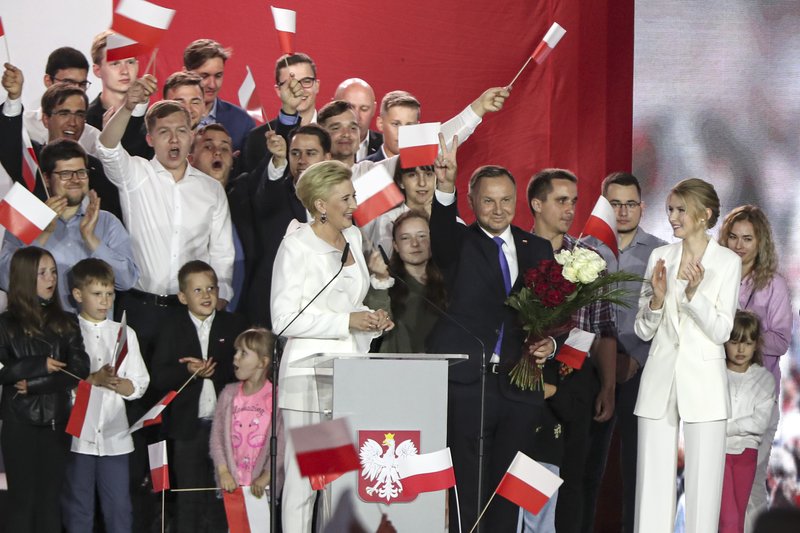
On Sunday, Poland’s Andrzej Duda won presidential reelection after failing to win a clear majority in the first round of voting in late June. Duda, a close ally of the right-wing Law and Justice Party (PiS), the largest member of the ruling coalitions in the Polish parliament, narrowly defeated the centrist Rafał Trzaskowski by a margin of 2.2%.
Poland’s reelection of the PiS-aligned Duda brings an electoral reaffirmation of Poland’s last five years, which has been dotted with anti-immigration rhetoric and clashes with the European Union. In April, the EU opened legal challenges against Poland for passing legislation that would bar judges from criticizing the government’s vast reform of the judiciary, one of many moves at the hands of PiS that has weakened Poland’s democracy. Rafał Trzaskowski, the Mayor of Warsaw and the centrist challenger to Duda in the second round, was able to narrow down Duda’s 13-point plurality in late June, by running on a liberal platform, promising to protect Poland’s democracy.
A Fierce Debate on Poland’s Values
At the forefront of the electoral campaign, though, was a conversation on Poland’s values, with Duda painting a stark contrast between the West’s liberalism and Poland’s traditional values, often rooted in Roman Catholicism. Trzaskowski, who as mayor promised to introduce education on LGBT rights in Warsaw’s schools and during the campaign announced his openness to reparations for the Jewish community because of Poland’s role in the Holocaust, was cast by the PiS and Duda as manifesting anti-Polish values. Throughout the campaign, Duda and PiS have been marred with criticism of homophobic, anti-German, and antisemitic rhetoric: Duda, on the campaign trail, called the LGBT “ideology” more dangerous than communism and alleged that German media was trying to infiltrate and influence the election.
Though PiS and Duda have been criticized internationally for their often controversial social views, they have been praised in the past for a low deficit and an attempt to balance Poland’s budget while expanding spending on welfare, including cutting taxes for citizens under 26 and doubling the minimum wage. Due to these economic reforms, PiS has remained fairly popular, winning a plurality of seats in the Sejm and Senate in last year’s parliamentary elections. Even Trzaskowski announced his support for keeping the current social welfare model intact if he was to be elected.
A Divided Poland
After Sunday’s results trickled in, the international community was given a clearer picture of the divisions within Poland. The results showed generational and territorial divisions that some analysts say will threaten PiS’ grasp on power and an insurgency of a modernizing generation.
Duda’s strongest age demographic were voters older than fifty, as revealed by an IPSOS exit poll. Trzaskowski, on the other hand, trounced Duda in voters under fifty, carrying 64% of 18-29 year olds who responded to the exit poll while carrying 55% of 30-39 and 40-49 year olds. Duda’s strength in the older demographic arises from the raising of pension payments and decreasing the retirement age to 65. Even though Trzaskowski carried more university-educated voters and voters located cities and towns, Duda’s grasp on the rural and Catholic aspects of Poland still remain intact.
Trzaskowki also won the most Polish provinces, carrying ten western provinces, while Duda only carried the six eastern provinces. This East-West divide reveals the gaps between the West, with its Austrian and Prussian history, and the lingering conservatism and religiosity from the Tsarist days in the East.
Some analysts are saying that these territorial and generational gaps will weaken the grasp PiS has on power, though the next legislative elections are scheduled for 2023 and Duda’s term will last for another five years until 2025.
 The Global Monitor